

Buying the thickest batting isn't a reliable way to get the puffiest finished quilt. High loft batting is a thicker, more resilient middle layer, but the useful measurement is how much lift remains after quilting and washing, not how impressive the loose batt looks out of its package.
For a dimensional quilt, Hobbs Cloudloft Polyester batting is a practical starting point. Its suitability still depends on your quilting design, machine clearance, and the way the finished quilt will be laundered.
Meta Title: High Loft Batting: Loft and Spacing | The Batting Company
Meta Description: High loft batting holds its puff only when quilted within the right spacing. Compare Hobbs and Pellon options, then shop the exact roll or package today.
URL Slug: /blogs/project-notebook/high-loft-batting-loft-and-stitch-spacing
What High Loft Batting Actually Measures
Loft is the height of the batting between the quilt top and backing. Think of a stack of pillows compared with a folded sheet. The pillows stand taller and spring back when you release them; the sheet lies flatter. Batting behaves in a similar way, although its construction determines how well it recovers.
The PBS America Quilts glossary describes the distinctions that matter in the quilt sandwich: higher-loft batting produces a fuller surface and deeper relief around quilting, while lower-loft material produces a flatter result with clearer visibility of closely spaced stitching.
Working definition: High loft describes thickness, puffiness, and resilience. It isn't a standardized warmth rating or a guarantee of finished quilt quality.
That raised surface suits comforters, tied quilts, and dimensional designs. Quilting lines settle into the batting, leaving the surrounding areas raised. If your design depends on intricate, closely packed stitching, however, additional bulk can make feeding harder without improving the visibility of the fine detail.
Choose the surface before choosing the thickness
Ask whether you want to see the stitched line itself or the raised shape around it. A flatter batting often serves detailed stitch work better. A lofty batting makes more sense when open areas and pronounced relief are part of the design.
Fiber also changes the feel. Polyester can provide substantial thickness at relatively low weight, while cotton-polyester blends add body without giving up all of cotton's softness and breathability. Neither description tells you exactly how the finished quilt will drape.
Early selection card
For a puffy machine-quilted or tied quilt: The linked polyester package is specified with approximately 5/8-inch loft, resin bonding, 4–6-inch quilting distance, and no shrinkage. Use those specifications to screen your design, then make a sample before committing the full top.
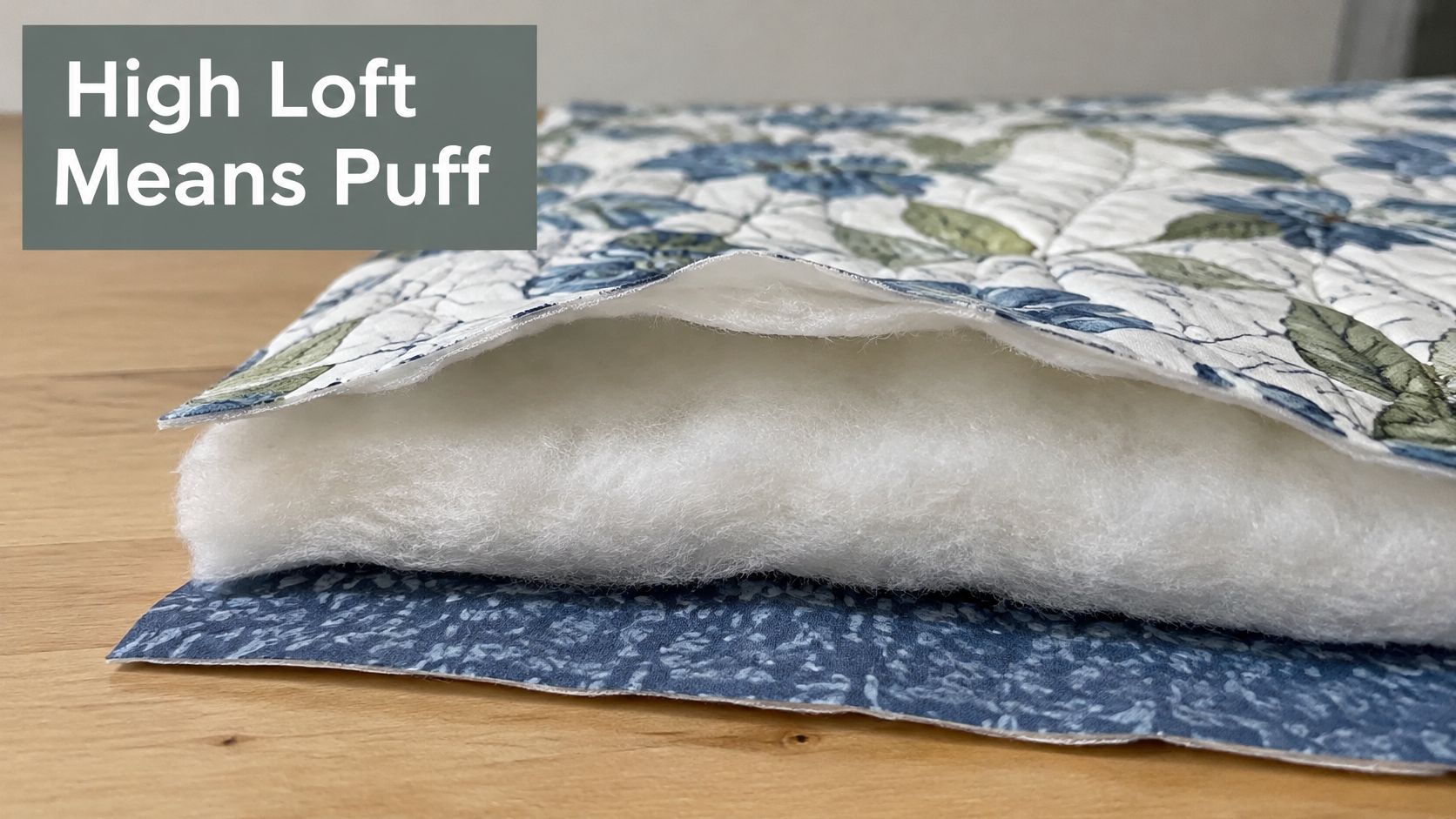
The important buying question isn't how thick the batt starts. It's whether the fiber, construction, stitching, and care routine will preserve the surface you want.
Fiber Choices and How They Hold Loft
Thickness establishes the starting profile; fiber and construction influence how that profile behaves during handling and laundering.
Fiber behavior for high loft batting
| Fiber | Loft behavior | Shrinkage and care | Best fit |
|---|---|---|---|
| Cotton | Natural hand and drape, generally flatter loft | Some cotton-based batts shrink on first washing; unsupported fibers can bunch or shift | Heirloom quilts that need breathability |
| Wool | Resilient loft and springy drape | Use the exact product's washing and drying instructions; test recovery after laundering | Quilts where springy lift is the goal |
| Polyester | Substantial thickness at low weight; retains loft | Resists shrinking and abrasion; excessive heat can distort it | Tied quilts, comforters, lightweight projects |
| Cotton-polyester blend | Added body with some cotton softness | Check the blend's stated shrinkage and care instructions rather than assuming polyester eliminates shrinkage | Everyday bed quilts that need balance |
The University of Idaho's quilting guidance identifies a useful practical contrast: cotton batting can bunch and shift during laundering, while polyester is lightweight, dries faster, and resists shrinking and abrasion. Polyester's disadvantages include lower breathability and sensitivity to excessive heat.
Match the fiber to the finished hand
Cotton makes sense when natural feel and drape matter more than a pronounced comforter profile. Fuller cotton constructions can add weight as well as thickness, so don't assume a more substantial cotton quilt will feel like a lightweight polyester one.
For example, Warm & Plush® Luxury Loft 100% Cotton Quilt Batting, 90-inch by 25-yard bolt, uses needled cotton without scrim and is described as containing 50% more cotton. It's a useful comparison for makers who want cotton's breathability with a heavier finished feel, rather than polyester-style puff.
Wool is worth considering when resilient lift and drape are priorities. Its appeal is spring rather than sheer bulk, but the care instructions still belong to the exact product, not to wool as a general category.
Blends offer a middle path. Compare them using the Hobbs batting comparison chart, then judge the actual sample against the feel your project needs.
For garments, the Idaho guidance favors thin-to-medium polyester because thicker batting can make clothing stiff and uncomfortable. Apply that same handling question to vests and quilted accessories: does the inner layer bend where the finished object needs to bend?
The buying rule is straightforward: compare stated fiber, dimensions, and construction of the exact product. A fiber name alone isn't a specification.
Quilting Distance and How Loft Changes After Stitching
Maximum quilting distance and shrinkage by batting construction
| Batting type | Construction | Max stitch spacing | Shrinkage |
|---|---|---|---|
| Unbonded high-loft batt | Unbonded fibers, no scrim | General guidance is about 3–4 inches; exact label governs | Read the fiber-specific product specification |
| Scrim-supported batt | Scrim-stabilized web | General guidance is approximately 8–10 inches; exact label governs | Scrim alone doesn't establish shrinkage |
| Cloudloft polyester | Resin-bonded polyester | Product-specified interval given in the selection card | None stated by the manufacturer |
| Fuller no-scrim cotton example | Needled cotton, no scrim | Up to 6 inches between quilting lines or ties | Verify the exact product; don't assign a generic cotton percentage |
The general 3–4-inch interval for unbonded high-loft materials and 8–10-inch interval for scrim-supported constructions come from Mrs Quilty's batting-distance guidance, which also reports approximately 3–5% first-wash shrinkage for some cotton-based battings, with warmer washing tending toward the higher end.
Those are construction-level comparisons, not permission to override a package label. The fuller cotton example demonstrates why: no scrim doesn't automatically mean one universal spacing limit. Needling, bonding, fiber arrangement, and the manufacturer's testing all matter.
Why spacing changes both stability and appearance
Unsupported fibers can move between anchor points. Leave too much open space and handling or laundering can produce bunching, thin patches, or migration. A pantograph that works with a stable scrim-supported batt may be inappropriate for a visually similar unbonded one.
Stitching also compresses the batt along every stitched path. Open areas remain fuller, while quilted channels become thinner. Cover the whole surface with dense stitching and you change the hand as well as the relief.
Textile work on lofty nonwoven materials indexed in Textile Research Journal found that thermal resistance and water-vapor resistance were determined mainly by sample thickness, with comparatively little dependence on fiber type within the materials studied. That supports treating thickness as useful information, but not as a finished-quilt thermal rating.
A quilt includes more than loose batting. Compression, density, moisture, and the top and backing affect the result. Evaluate the quilt sandwich you'll use, not an isolated sheet held up to the light.
A maximum quilting distance is a ceiling, not an instruction to leave every area as open as possible.
For a softer, puffier result, preserve open space within the product's permitted limits. For detailed motifs, accept that additional stitching will compress more of the surface. Don't add dense filler automatically if the goal is an airy bed quilt.
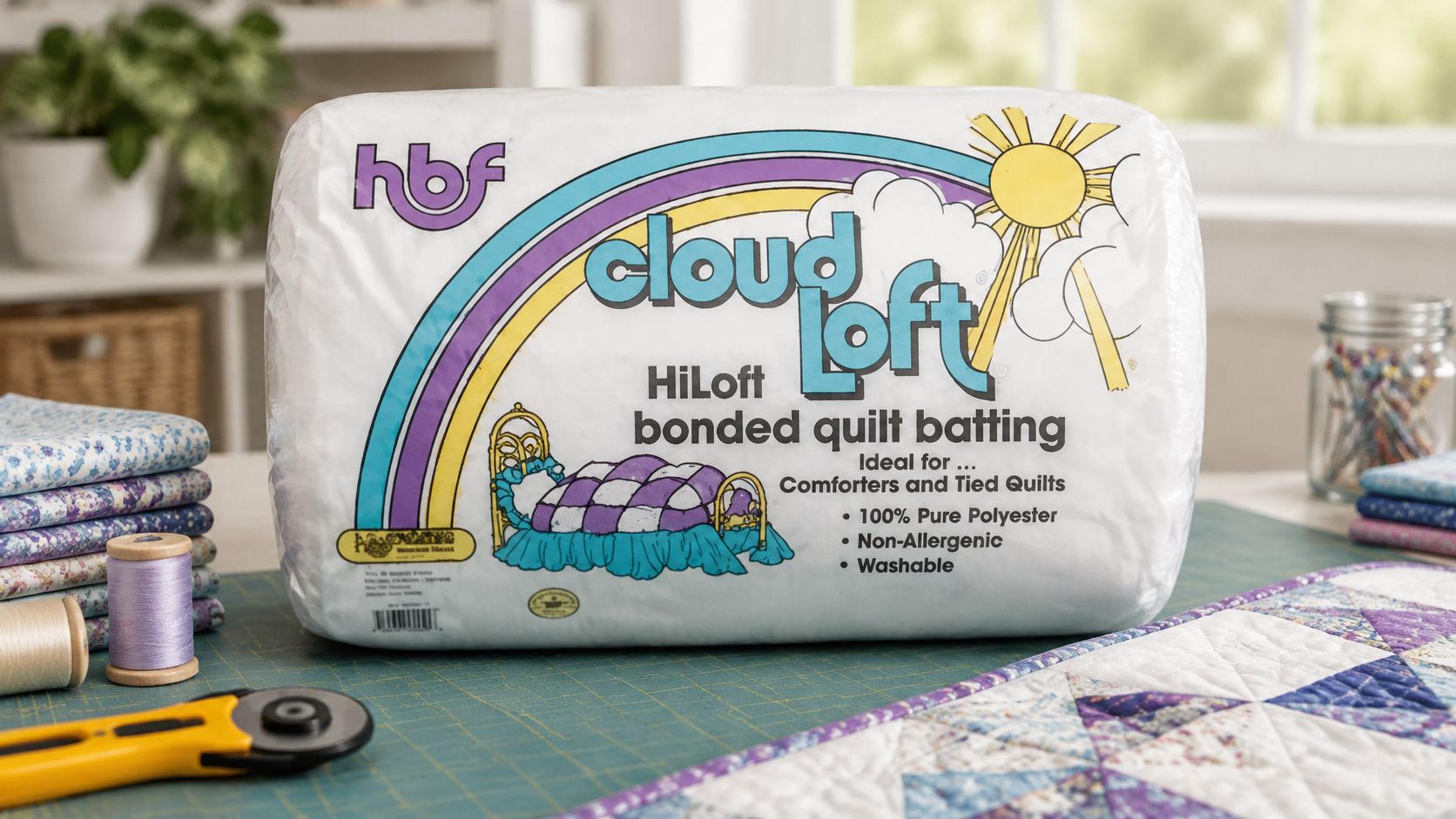
The illustrated queen package is resin-bonded polyester intended for projects including machine-quilted and tied quilts.
Check the design before loading the quilt
Use the Hobbs recommended-use and specification chart as a planning aid, then read the exact product's maximum quilting distance, shrinkage, and washing instructions.
Before quilting, make these checks:
- Identify the stabilizing construction. Establish whether the batting is bonded, scrim-supported, needled, or unsupported.
- Find the largest open gap. Measure between adjacent quilting paths, including borders and negative space, rather than relying on the nominal pantograph size.
- Check the care plan. Make sure the intended wash and dry routine matches the product instructions.
- Balance the density. Avoid a heavily compressed center surrounded by largely unquilted borders unless you've tested that combination.
For bed quilts, the wash test deserves particular attention. A sample that looks balanced straight off the frame may pucker after laundering. Correcting the spacing on a sample is much easier than correcting it after binding.
Matching Your Machine to High Loft Batting
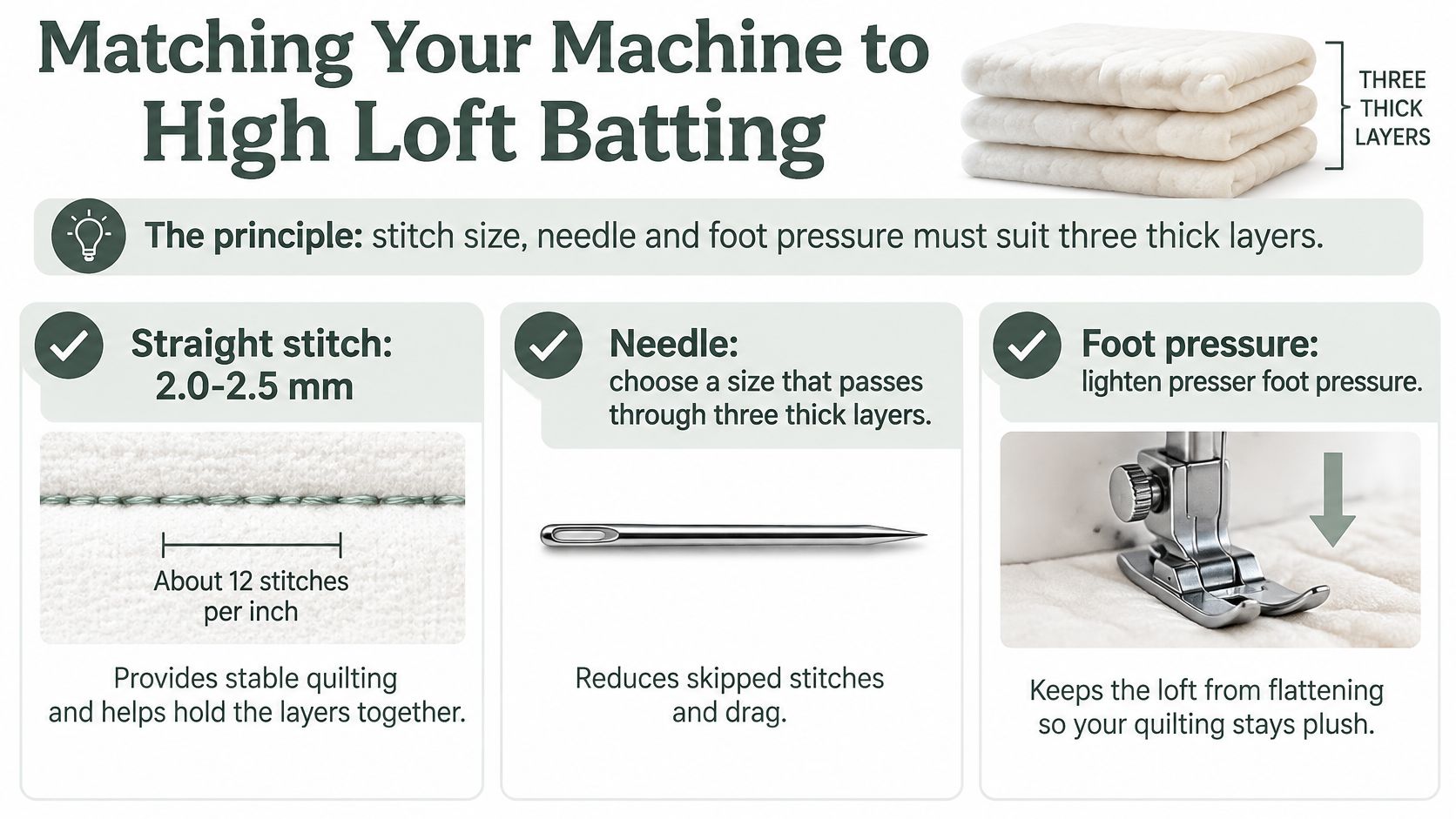
Stitch length, needle choice, and foot pressure must suit the complete sandwich. A setting that works on a flat cotton batt isn't automatically suitable when the inner layer is thicker and more resilient.
The University of Kentucky's quilt-construction guide provides useful starting settings, not a universal high-loft prescription:
- General straight stitching: Around 2.0–2.5 mm, described in the guide as approximately 12 stitches per inch.
- Shorter-stitch work: Some situations call for 1.5–2.0 mm, described as roughly 15–16 stitches per inch.
- Needle baseline: A #12/80 needle is recommended for cotton fabric with mid-loft batting. Don't assume that size will suit every thicker sandwich.
- Presser-foot pressure: Reduce it when necessary so the layered quilt feeds without excessive compression or pushing.
- Domestic-machine feeding: Use a walking foot for walking-foot quilting, then test the actual fabric, batting, and thread combination.
Domestic machines and longarms have different limits
On a domestic machine, usable space matters as much as needle penetration. Support the quilt's weight beside the machine so it doesn't pull against the needle, and arrange the bulk without crushing it into a rigid bundle. Slow down when the layers stop feeding consistently.
A walking foot isn't the appropriate foot for every technique. Free-motion quilting requires the machine setup intended for that method, with a sample used to establish controllable movement and reliable stitch formation.
Longarm users should check tension, drag, and the underside of the sample before loading a customer's full top. Inspect dark fabric for visible fibers, and don't turn a product's resistance to bearding into a promise that bearding can never occur.
For preparation tools, our quilting supplies guide for beginners provides a useful checklist even when the quilting itself isn't beginner work.
Allow extra batting as required by your quilting method or longarm provider. Compare the top's size, handling allowance, machine capacity, and planned spacing before selecting the package or roll width.
How to Test Loft in a Stitched and Washed Sample
A useful sample reproduces the actual project, including its less convenient details. Substitute a different backing or a looser quilting design and you may solve a problem the finished quilt won't have.
Make the sample representative
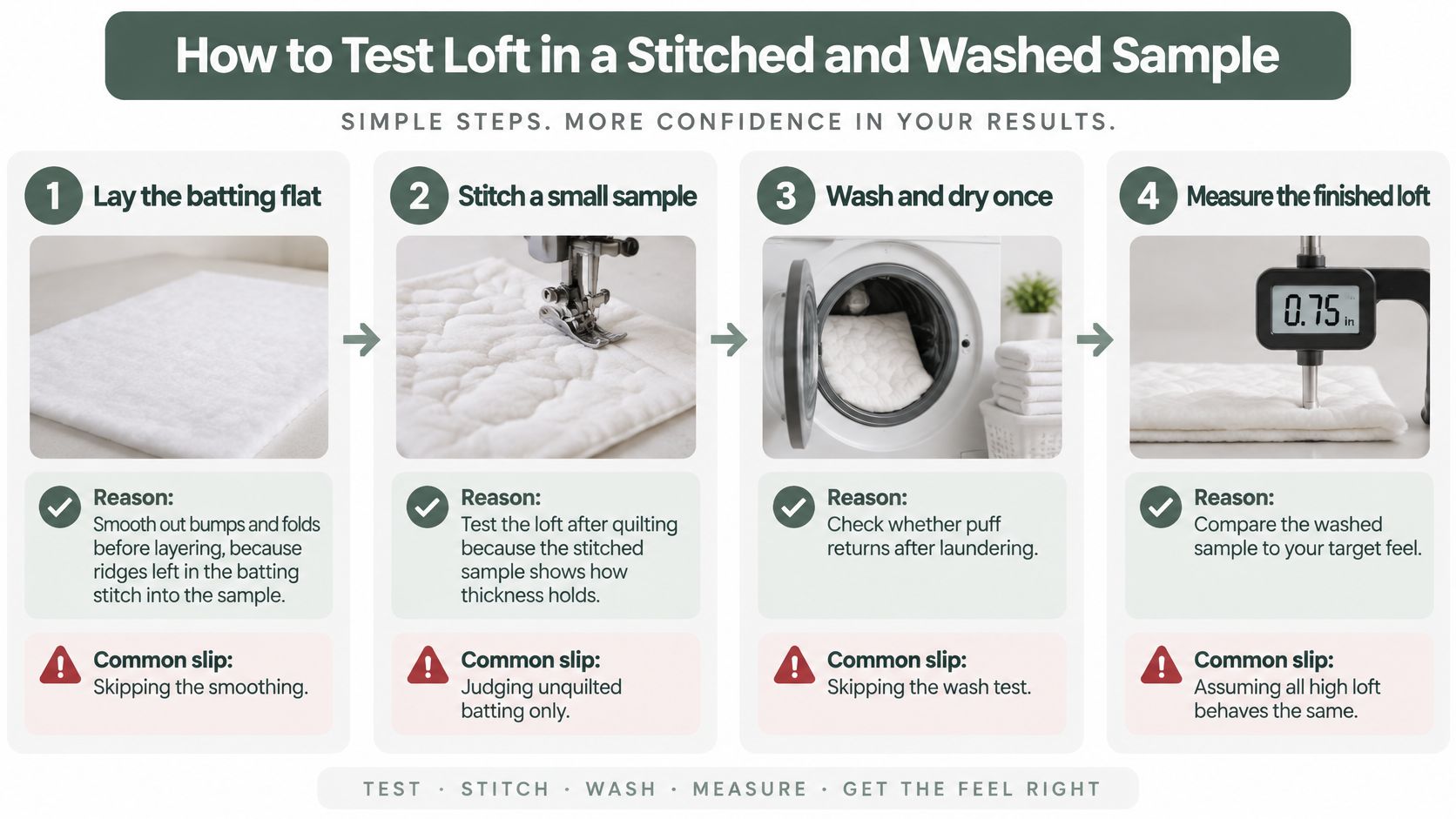
- Lay the batting flat and smooth it before layering. Work out folds and bumps without stretching the web. Skipping this step can leave ridges trapped inside the stitched sandwich.
- Build the sample with the actual top fabric, backing, batting, and thread. Include a seam intersection if the quilt contains bulky piecing; a sample made entirely from smooth fabric won't reveal that handling issue.
- Quilt the intended design at the intended density. Utah State University Extension's machine-quilting guidance recommends smoothing the batting, using small, even stitches, and securing quilting starts and ends with two or three tiny back-and-forth stitches. Use an appropriate securing method for your machine and technique rather than leaving the sample's stitching unsecured.
- Record the sample's dimensions and check thickness at several marked locations. Include both open areas and stitched channels, using the same light measuring pressure each time; squeezing the sample makes the comparison unreliable.
- Wash and dry the completed sample as the finished quilt will be cared for, within the manufacturer's instructions. Don't confuse testing a quilted sample with prewashing loose batting, which may be prohibited.
- Measure again after the sample is dry and relaxed. Compare the same locations, and note surface texture, drape, fiber migration, and any distorted edges as well as thickness.
- Use the result to finalize the project. Adjust spacing, handling allowances, and care instructions before cutting the full batting. If the result fails your expectations, change a specific variable and test again.
Keep evidence, not just impressions
A successful sample has the lift you want, predictable dimensional change, and a surface that lies acceptably flat. There's no universal acceptable percentage of loft loss for every quilt. A dimensional display quilt and a frequently washed bed quilt have different priorities.
Keep the label with the sample. Product identity and care instructions are more useful than a note that only says polyester or cotton.
For a batting defect claim, Hobbs may require a 12-inch by 12-inch batting sample and the package label to assess a refund or replacement. Keep those materials separate from general sewing scraps.
When testing a pieced top, our layer cake quilting guide can help you plan a representative fabric arrangement rather than sampling only the easiest part of the project.
Frequently Asked Questions About High Loft Batting
What is the maximum stitch distance for unbonded high-loft batting?
Unbonded batting generally needs closer anchoring than a scrim-supported construction. Use the construction-level intervals in the spacing table for initial screening, then follow the exact package specification.
Check the widest unstitched area, not merely the average spacing across the quilt. Borders and large background shapes need the same attention as the center.
Does high-loft batting make a quilt warmer?
Greater retained thickness can improve insulation by maintaining more still air within the fibrous layer. It doesn't follow that every batting labeled high loft will produce a warmer finished quilt than every lower-loft alternative.
Quilting compression and the surrounding fabrics change the result. Choose for the finished sandwich and intended use, rather than treating loft as a temperature rating.
Can I machine quilt high-loft batting on a domestic machine?
Yes, provided the machine can handle the sandwich and you can move the quilt without forcing it. Start with a suitable foot, appropriate needle, controlled pressure, and the construction settings described above.
The mid-loft needle recommendation isn't a guarantee for a much thicker batt. If the sample shows skipped stitches, drag, puckering, or uneven feeding, resolve that before quilting the full top.
How much does cotton batting shrink?
Some cotton-based battings fall within the first-wash range given in the spacing guidance, but that range isn't a specification for every cotton product. Construction and laundering conditions matter.
Read the exact shrinkage and care information, then test the assembled sandwich. The dimensions of the washed quilt reflect the behavior of its fabrics and stitching as well as its batting.
For a product-by-product comparison, keep the manufacturer chart and the package care label with your project records.
Ready to Start Your Next Quilt? Stock Up on Exact-Spec Hobbs & Pellon Batting
Cost per square yard for each roll and package
| Product | Size | Price in USD | Square yards | Calculated cost per square yard |
|---|---|---|---|---|
| Hobbs Heirloom 80/20 natural roll | 96 in × 30 yd | $199.99 | About 80 | About $2.50 |
| Hobbs Heirloom 80/20 wide roll | 120 in × 30 yd | $229.16 | About 100 | About $2.29 |
| Pellon Wrap-N-Zap microwaveable cotton batting | 45 in × 1 yd | $10.45 | About 1.25 | About $8.36 |
The calculation is width in yards × length in yards, followed by price divided by area. These figures compare material area, not landed cost or finished-quilt yield. Shipping, cutting waste, and required handling allowances aren't included.
The wider roll has the lower calculated area cost, but only offers useful value when its width suits your work. A narrower roll can be the better purchase if it reduces unusable offcuts across your usual quilt sizes.
Choose the material before choosing the order size
The cotton-polyester rolls are options for makers seeking a balanced bed-quilt hand. They aren't direct substitutes for a pronounced polyester comforter profile because the bulk economics look attractive.
Likewise, the microwaveable cotton package serves a different application. Don't choose a quilt batting for microwave use based on fiber name alone, and don't treat the price table as a safety approval for a complete bowl cozy or potato bag. Every component and the finished project's use must meet the relevant product instructions.
For another way to compare materials before standardizing studio purchases, review the Hobbs queen-size batting package sampler. Verify its contents against the materials you want to test.
For a single project, choose the package whose dimensions, construction, and intended application fit the job. For repeat longarm or guild work, compare roll width against your recurring cutting layouts, then buy bulk only after the stitched-and-washed sample passes.
Exact ordering assistance is available from our team at support@battingcompany.com or +1 (972) 542-4000. Before checkout, confirm the selected product's quilting distance, shrinkage, washing instructions, and required cutting allowance.
The Batting Company offers Hobbs batting and Pellon materials for project-specific packages and repeat-production needs. Visit The Batting Company to compare exact specifications, then choose the package or roll that matches your tested quilt sandwich.