

A standard layer cake is 42 coordinated 10 by 10 inch squares, and those squares laid out in a simple 6 by 7 grid finish into a quilt top of about 57 by 66 inches before borders and binding. That single line carries most of the planning: the pack sets your block count, and the block count sets the top. Nothing about the package label sets the finished size.
The commercial weight behind that tidy bundle is larger than most new quilters expect. A University of Minnesota study of the precut fabric market traces layer cakes to the precut movement that followed Moda's 2006 introduction of Jelly Rolls, and reports that precut fabrics represented 25% of Moda Fabrics' total sales within ten years. Standardized bundles stopped being a convenience and became a category.
Which is exactly why the sizing questions pile up. A shopper holds one pack, reads "42 squares, 10 inches," assumes a 60 by 70 inch quilt, then finds the finished top is smaller, the batting needs to be bigger still, and the cotton moves again in the first wash. Layer cake quilting gets predictable the moment you work the numbers in the order they matter: what's in the pack, what the pack can't do, how many packs a bed needs, how much the top shrinks, and what size batting that leaves you buying.
What a Layer Cake Contains and How Big It Is
Start with the area, because every later calculation in layer cake quilting spends from it. Forty-two coordinated 10-inch cotton squares hold 4,200 square inches of fabric, which the Moda Fabrics brand guidelines record as approximately 29.2 square feet, or about 3.24 square yards before selvage, seams, cutting waste and layout come out of it. That is the budget. No finished-top figure you plan later can exceed it.
The deductions arrive in a fixed order. Selvage goes first. Seams come next: every square that joins a top gives up fabric along all four edges, so the face it shows in the finished quilt is smaller than the 10 inches printed on the label. Cutting waste follows, and it scales with how hard you work each square. A square left whole keeps the most of its 100 square inches. A square cut into strips or half-square triangles converts part of that area into seam allowance and offcuts before it ever reaches the design wall.
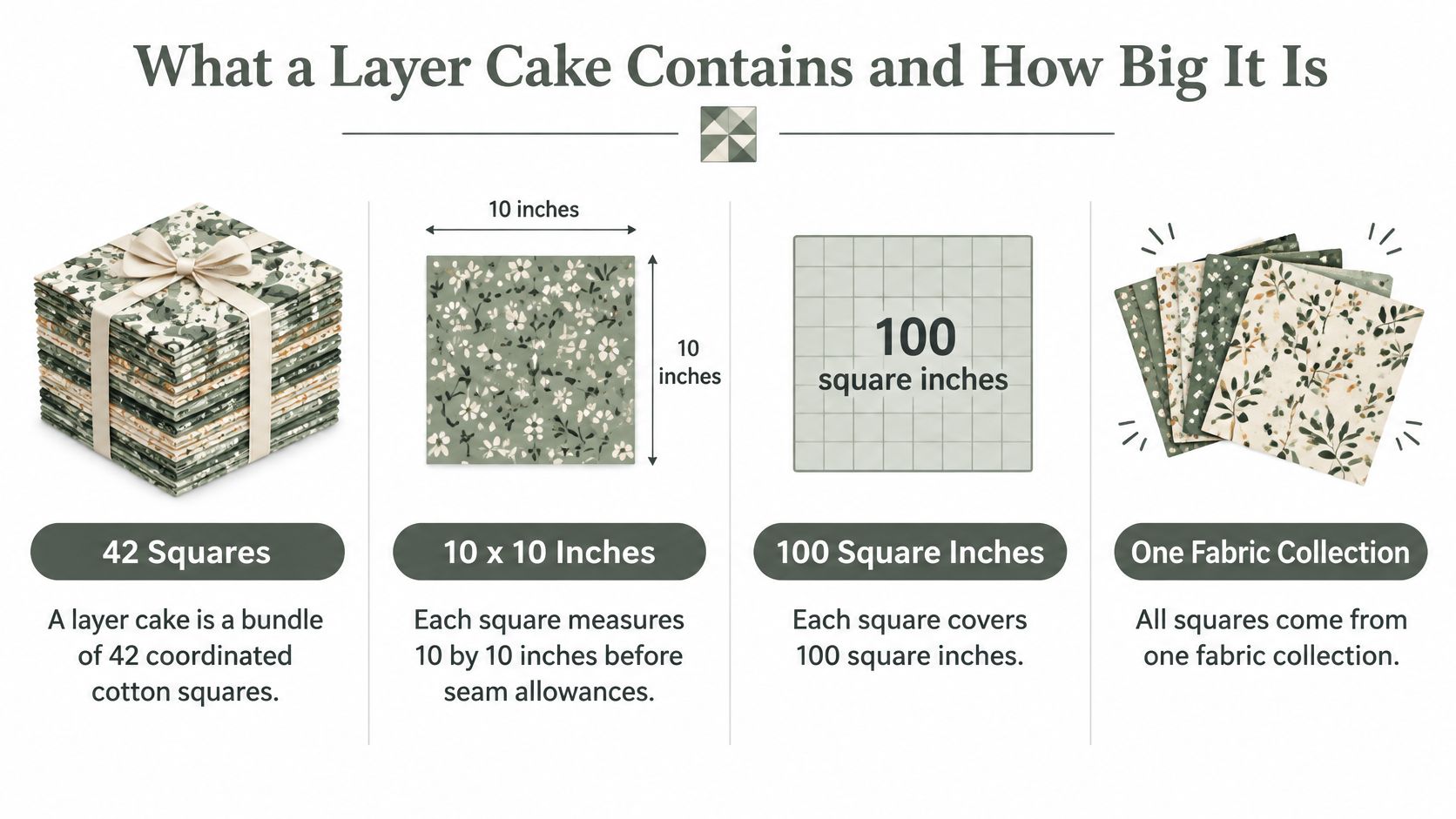
The 10-inch dimension is what makes the format flexible. It is twice the width of a 5-inch charm square, so a large-scale print stays readable instead of being chopped into fragments that lose the design. One square can stay whole as a single patchwork unit, subdivide into smaller pieces, or be fussy-cut around a single motif. Smaller precuts force that decision earlier and with less fabric to spare.
Pack counts move between collections. A 40-square bundle holds 4,000 square inches, not 4,200, so the label on the pack is the final check rather than a count carried over from the last bundle you bought.
In plain terms. The pack works like a box of building blocks counted in pieces. The quilt is the wall you build from them, and the wall's size comes from how you arrange the blocks, not from how many sit in the box.
One check to run with any pack, in the aisle or in your stash: count the squares and multiply by 100. The answer is your starting budget, and the finished top is what remains after every step above has taken its share.
When a Layer Cake Is the Wrong Choice
The sales pitch for precuts is that they save fabric. What they save is cutting time, and those are different claims.
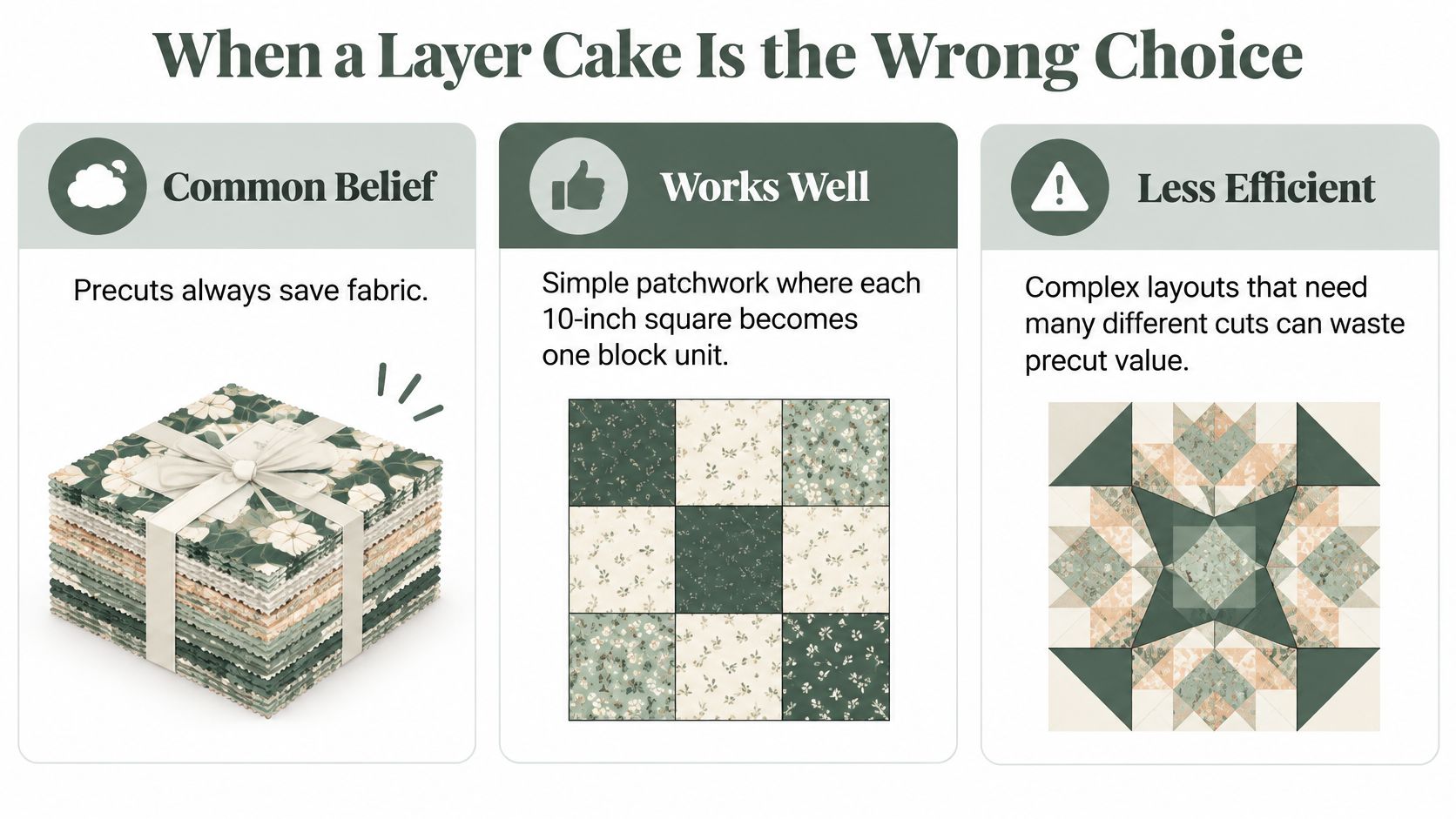
A layer cake earns its price in simple patchwork, where each square becomes one block unit and almost nothing is trimmed away. It loses ground in three situations you can spot before you buy.
Half-square triangles and other subcuts. Cut every square into triangles, sew, then trim to size, and the seam allowances plus trim waste take a real share of those 4,200 square inches. The yield still looks generous on paper: one square gives four 5-inch pieces, so a 42-square pack can produce about 168 charm-sized squares, as the Missouri Star layer cake pattern guide sets out. Those 168 pieces only pay off if the pattern calls for them.
Long strips and borders. A 10-inch square cannot yield a continuous strip longer than 10 inches, so a pattern needing 42-inch border runs will waste most of the square or send you back to the bolt. If your taste runs to smaller precuts anyway, the Fat Quarter Fun quilt pattern is drafted for fat quarters rather than 10-inch squares.
Directional prints and fussy cuts. When a print has an obvious up direction, or you want a motif centered, each square gives fewer usable pieces than its area suggests. Duplicate prints make this worse, since two identical squares can't both be the star of the layout.
Rule of thumb. If the pattern's first instruction is "cut each square into," price the yardage before you price a second pack.
Here's the layout thinking before you commit the whole bundle:
Kitchen projects are the exception where the square is right but the inner layer decides everything. Pellon's Wrap-N-Zap guidance permits only 100% cotton batting, thread and fabric, no scrim, and no more than two batting layers including at seams, with cooking in one-minute intervals up to eight minutes; the product is not fire-retardant or flameproof.
Four checks before the rotary cutter comes out:
- Count the squares. Confirm the pack matches what the pattern assumes, not what the shelf tag promised.
- Measure several pieces. Pinked edges can push the usable dimension under the nominal 10 inches.
- Inspect the edges. Heavy fraying or a crushed fold changes how the square sits against your ruler.
- Sew one block and wash it if shrinkage or color movement matters for the finished piece.
The decision rule is plain. Compare the usable area one pack delivers for your actual pattern against the yardage that same pattern needs, then buy the cheaper route. Nominal count never enters into it.
How Many Layer Cakes Your Quilt Needs and How to Calculate It
Read the lookup first, then run your own target against it.
| Quilt size | Layer cakes (approx.) | Basis |
|---|---|---|
| Lap or small throw | 1 | 6 x 7 grid of 42 squares, about 57 x 66 in before borders |
| Twin | about 2 | Block design, sashing, borders and waste set the final count |
| Queen | about 3 | Block design, sashing, borders and waste set the final count |
A standard layer cake is a bundle of 42 factory-cut 10 x 10 inch cotton squares, though the exact count can vary by collection. In simple patchwork each square commonly finishes at about 9.5 by 9.5 inches after a quarter-inch seam on all four sides, so 42 finished squares arranged 6 by 7 make a top of roughly 57 by 66 inches before borders and binding, as the Missouri Star layer cake collection guide documents. One pack covers many lap and throw projects, twin designs generally take about two, and queen-sized designs about three.
Where the 57 by 66 comes from
Seven squares across at 9.5 inches finished gives 66.5 inches of length. Six rows at 9.5 inches gives 57 inches of width. Trim the half inch of rounding and you have the working figure. A pattern built on half-square triangles, flying geese or any other subcut reduces usable area further through seam allowances and trimming, so treat 57 by 66 as a best case for whole squares.
Seven steps from a target size to a pack count
- Set the finished target. Write the width and length you want in inches, borders included.
- Confirm the pack. Count the squares and measure a few, since pinked edges and collection counts both move.
- Choose the block layout. Whole squares use the most fabric, while subcuts consume more.
- Do the grid math. Multiply columns and rows by 9.5 inches, then add sashing and borders.
- Buy the background. If the pack doesn't supply sashing or background fabric, add yardage from the layout.
- Sew, press, measure and wash a test block when shrinkage matters for the finished piece.
- Measure the washed top and add the batting and backing overage your quilting method or longarm provider requires.
Worked example, a 60 by 70 inch target
That target exceeds the 57 by 66 base top, so you have two honest options. Add a 3-inch border on every side and 57 by 66 becomes 63 by 72 inches. Or buy a second pack and build more blocks. Both are valid, and both should be decided on paper before fabric is cut.
Counts and edges vary enough that the numbers deserve a second look. The High Country Quilts layer cake planning notes make the point that a standard pack is described as 42 squares of 10 inches while some collections differ, and that the "2¾ yards" figure attached to a pack is an area equivalence rather than a continuous length you can cut like yardage.
Finish by checking that three numbers agree: the base top, the border additions, and the batting size. When they don't, fix it on paper. Fabric is the expensive place to discover a two-inch error.
Why Shrinkage and Seam Accuracy Change the Final Size
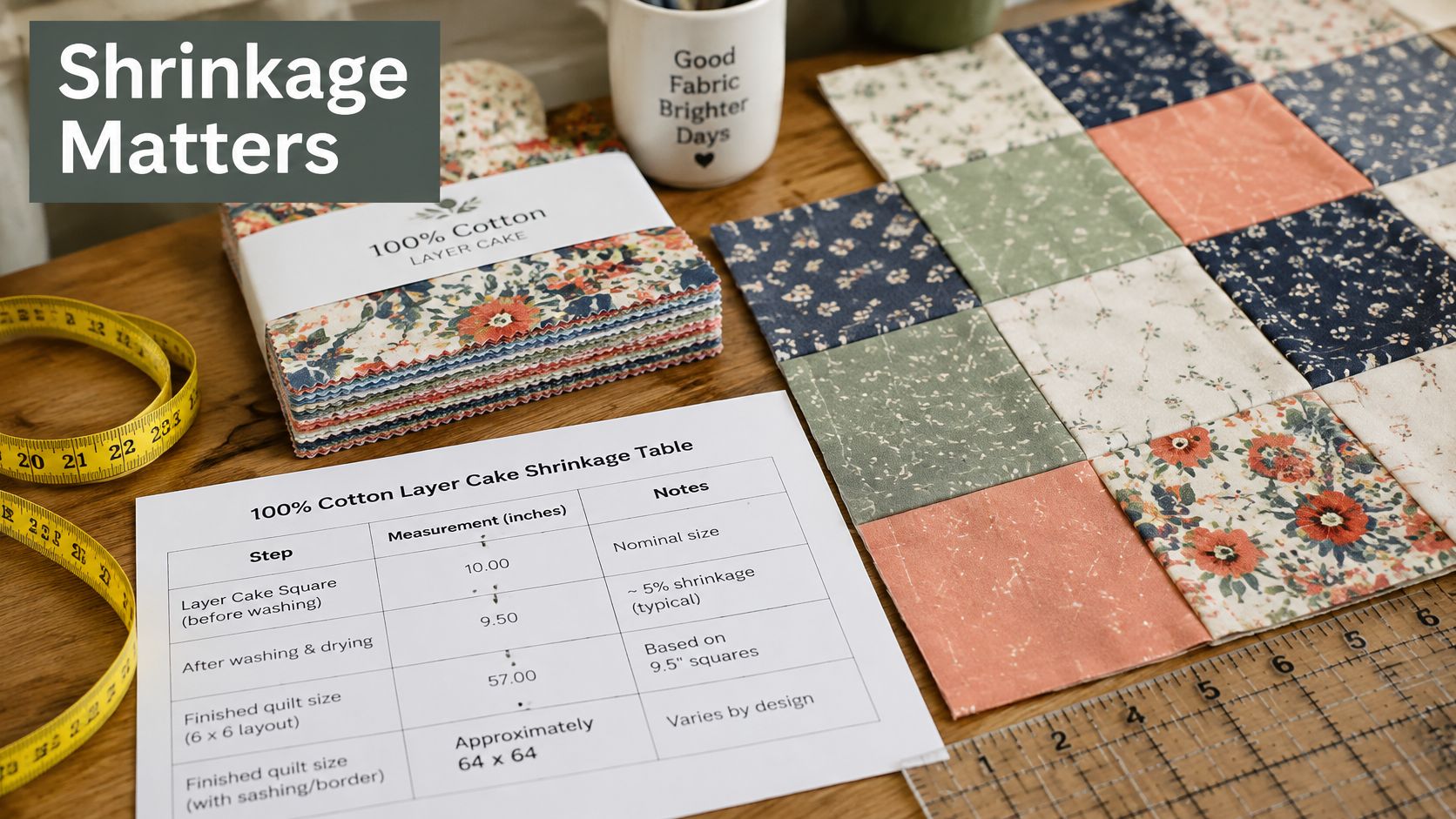
A 57 by 66 inch top rarely finishes at 57 by 66. The published specification for Moda layer-cake fabric lists 100% cotton construction, approximately 3 to 5 percent expected shrinkage, a medium weight of about 150 gsm, and a 60 by 60 thread count, as the Wool Warehouse listing for Moda layer cakes records. Applied to that top, the range lands the finished quilt roughly one and a half to three inches smaller on each side.
| Stage | Width x length (inches) | Note |
|---|---|---|
| Unwashed top before borders | 57 x 66 | Nominal patchwork size with quarter-inch seams |
| After 3% shrinkage | about 55.3 x 64.0 | Lower end of the published range |
| After 5% shrinkage | about 54.2 x 62.7 | Upper end of the published range |
| Quilting draw-up | Measured after quilting, not predicted | Set by stitch density, batting and fabric finish |
Shrinkage works like a percentage discount applied twice: once to the width and once to the length, so the total area loss is larger than the single figure suggests. That math drives a decision you can't dodge. Prewashing stabilizes the cotton before precise piecing, but it changes the hand of the fabric and increases edge fraying on pinked squares. Skipping the prewash preserves the full 10-inch cut and moves the shrinkage risk onto the completed quilt.
Seam accuracy compounds the same way. A consistent scant quarter-inch matters because a small repeated error multiplies across six or seven blocks in each row: an eighth of an inch lost per seam becomes nearly an inch across a single row. Measure the sewn units rather than trusting the nominal square size, press every seam the same way, and sew a single test block before committing 42 squares. A dull blade shows up first as frayed, slightly uneven cut edges and skipped threads along the cut, so swap in Linda's 45mm ergonomic rotary cutter replacement blades as soon as yours drags or leaves uncut spots.
Write down the measured size. Once the top is washed and pressed, measure it and record the figure. Batting and backing overage come from that measurement, not from the plan you started with.
For longarm or production work, that recorded measurement is the handoff number. Everything downstream is cut to it.
Batting Size and Quilting Spacing for Layer Cake Tops
Batting is ordered from the finished top, never from the pack. Allow extra batting as required by your quilting method or longarm provider, and read the exact product's maximum quilting distance, shrinkage and washing instructions before deciding. Start with the lookup numbers, then work out why they matter.
| Batting | Loft | Shrinkage | Max stitch spacing |
|---|---|---|---|
| Hobbs Heirloom Premium 100% Natural Cotton | about 1/8 in | 3-5% | up to 4 in |
| Hobbs Heirloom with polyester scrim | about 1/8 in | 3-5% | up to 8 in |
The Hobbs Heirloom cotton batting page lists both versions as needle-punched to roughly an eighth of an inch with a 3 to 5 percent shrinkage expectation. The difference sits in the last column: the polyester scrim raises the maximum distance between lines of stitching from 4 inches to 8.
That gap decides pattern choice as much as batting choice. Maximum quilting distance is the widest gap allowed between stitching lines anywhere on the quilt, so a layer-cake top with large open blocks or a widely spaced pantograph sits comfortably inside the scrim version's limit and uncomfortably close to the plain cotton's.
Then there's warmth. In its quilting FAQs, Hobbs explains that larger air pockets retain more warm air, so a quilt stitched extremely closely won't be as warm as one quilted 2 to 4 inches apart. A moderate interval near the lower end of the allowance keeps more insulation than dense stitching, provided you stay under the stated maximum.
Ask before you order. The overage a longarm quilter needs varies with frame and setup. Get the number first, then buy to it.
Once you have it, the arithmetic is short. Say the washed top measures 63 by 72 inches and your provider wants 4 extra inches on every side: the batting has to cover at least 71 by 80, and the stitch plan still has to stay inside the product's limit. For tops at that scale, the Hobbs Heirloom 80/20 Batting Roll in 96 inches by 30 yards is an 80 percent cotton, 20 percent polyester blend needle-punched to roughly 1/8-inch loft, with a 3 to 5 percent shrinkage expectation, a 4-inch maximum stitch distance and enough width to cover most queen and king tops in one piece.
Comparing fiber and loft across the full Hobbs line takes less time with the Hobbs batting comparison chart PDF open beside your notes.
Frequently Asked Questions About Layer Cake Quilting
How many layer cakes does a twin quilt need?
Two. Start from two packs for a twin, then let block design, sashing and borders move the count up or down from there. The count also sets the batting footprint: a twin-size package such as the 72 x 96 inch Pellon Bamboo/Cotton Batting Scrim is sized for tops in that range, plus the overage your quilting method or longarm provider requires. If the provider's margin pushes the batting past that footprint, buy the next size up rather than trimming the top. The beginner longarm quilting tips for pantograph users guide explains how that overage is measured before you order.
Does a layer cake always save fabric?
It saves cutting time every time. Whether it saves yardage depends on how much of each square the pattern uses. Run the comparison before you buy: what one pack yields for your pattern against the pattern's stated yardage. Watch for the two-pack trap, where the yield leaves you a few squares short and the second pack is mostly leftovers. In that case, one pack plus matching yardage for the shortfall is usually the cheaper route.
Is every layer cake 42 squares?
Usually, but counts differ by collection, so count the stack before you plan the grid. The count sets every sub-cut that follows: a full 42-square pack becomes 168 five-inch squares or 672 two-and-a-half-inch squares, and a pack that arrives even a few squares short breaks a layout you planned from the label.
Should I prewash layer cake fabric?
Only if you want the shrinkage settled before you sew, and handle it gently because pinked edges fray in a machine wash. The practical test costs one square: wash and dry it the way you will treat the finished quilt, measure it before and after, and use that difference as the accurate shrinkage figure in your finished-size math.
Ready to Start Your Next Quilt? Confirm Your Layer Cake Plan Before You Order
One number remains before the order goes in. The earlier sections produced a finished target, a pack count and a washed top measurement. What those cannot tell you is the batting overage, the extra width and length your quilting method or longarm provider requires around the top. That allowance is set by whoever quilts the piece, so confirm it before you buy. A batting that matches the top exactly still fails if it arrives short on the frame.
With the overage settled, match the batting format to the job. A single layer cake quilt pairs with a packaged batting such as the Linda's Deluxe Cotton/Poly Blend Batting Queen Size 3 Yard Package - Made by Hobbs. Whichever batting you choose, read its product page for the exact maximum quilting distance, shrinkage and washing instructions, since those figures differ from one batting to the next. For a run of quilts or regular longarm work, a Hobbs roll, including the 96-inch by 30-yard size, lets you cut each piece to the top waiting on the frame.
If the piecing side still needs tools, the guide to quilting supplies for beginners covers the small items that cause the most rework.
Write the finished size first. Pack count, washed measurement, overage and batting width all follow from it, and none of them can be recovered cheaply once the rotary cutter has moved.
The Batting Company, operated by Red River Quiltworks, LLC, carries the Hobbs and Pellon inner layers this kind of planning lands on, from packaged batting in crib, throw and twin sizes to wide rolls for higher-volume cutting. Once your washed top is measured and the overage confirmed, matching a batting to it takes one comparison rather than a guess. Visit The Batting Company to line up the batting for your next layer cake top.