

You're halfway across a T-shirt quilt top when the rhythm changes. The machine sounds fine, but the seam doesn't. There are skipped stitches in the jersey, tiny holes where yarn should be, and a short ladder run starting beside the needle line. That's not usually a tension problem first. It's a point problem. Knits are built from loops, and a sharp tip can cut those loops instead of passing between them. Ball point machine needles solve that mismatch, but only when the size, point grade, and machine system are also right. Get one of those three wrong and you'll still see skips, snags, or needle breaks.
Why Knit Fabric Needs a Ball Point Needle
A ball point machine needle has a rounded tip that pushes between the loops of knit fabric instead of cutting through yarn, protecting jersey, interlock, and spandex blends from runs, holes, curling, and skipped stitches. It's also sold as a jersey needle, and that second name tells you its home territory. Woven cloth is a grid of warp and weft threads. A knit is a chain of interlocked loops that has to keep flexing after you've sewn it.
Say you're quilting a T-shirt top stabilized for the frame, with each block a different weight of jersey. A sharp point treats every block like quilting cotton. It pierces yarn, leaves a broken loop, and that loop can ladder when the quilt is stretched over the rollers or washed. A rounded tip parts the loops, lets them close around the thread, and keeps the stretch structure intact.
The Sewing and Craft Alliance needle chart specifies ball-point sizes from 70/10 through 100/16 for knits and distinguishes them from sharp or Microtex needles for finely woven fabrics. That range matters because ball point describes tip geometry, not a complete needle. You still choose shaft diameter for fabric weight, point grade for how rounded the tip is, and the needle system your machine was timed for.
What to decide before you sew
- Fabric construction: Is it a stable knit, a high-stretch knit, or a woven in disguise?
- Fabric weight: Light jersey and dense sweatshirt fleece don't take the same diameter.
- Machine system: A domestic needle, a serger needle, and a longarm MR needle aren't interchangeable.
For the T-shirt quilt itself, choose the inner layer by comparing the stated fiber, dimensions, and construction of the exact product, and allow extra batting as required by your quilting method or longarm provider. Then work through the size chart, the loop mechanics, the point comparison, project matches, and the troubleshooting order below before you commit the top.
Ball Point Needle Sizes for Every Knit Fabric
Start with the lookup, then test it. The chart below maps fabric weight to needle size and point grade together, because buying one without the other is how a correct-sounding purchase still fails at the machine.
| Knit fabric group | Needle size | Point grade | Example fabrics |
|---|---|---|---|
| Sheer to lightweight knits | 70/10-80/12 | Light ball (SES / FFG) | Jersey, tricot, single knit, spandex blends |
| Medium-weight knits | 80/12 | Medium ball (SUK / FG) | Ponte, interlock, T-shirt jersey |
| Medium to heavy knits | 90/14 | Medium ball (SUK / FG) | Double knit, sweatshirt fleece, French terry, sweater knit |
| Coarse knitwear and dense woven elastic | 90/14-100/16 | Heavy ball (SKF) | Chunky sweaters, dense elastic casings |
| Coarse elastic materials | 90/14-100/16 | Special ball (SKL) | Wide elastic bands, heavy stretch trims |
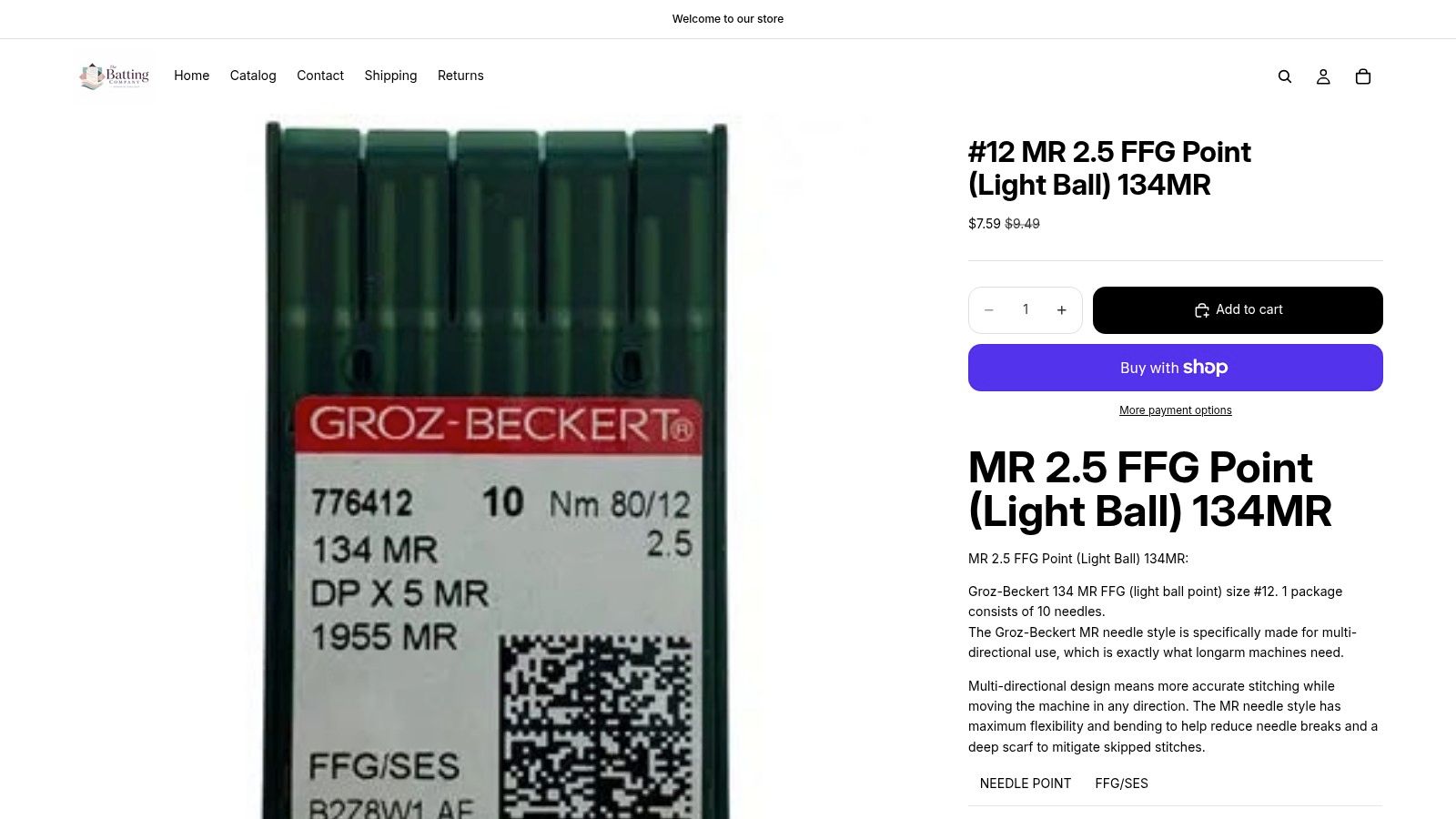
The product listing below shows how a light ball specification reads in longarm terms, with the point grade, size, and needle system stated separately.
How to read the two numbers
The size is shaft diameter. In the metric NM system, the number maps directly to that diameter: a 90 runs a thicker shaft than a 70, while the tip shape comes from the grade code printed beside it. Those codes describe the ball itself. SES, also called FFG, is a light ball for fine knits. SUK, also called FG, is a medium ball for jersey, fleece, and sweatshirt weights. SKF is a heavy ball for coarse knitwear and dense woven elastic, and SKL is a special ball for coarse elastic materials.
Singer's needle selection guidance specifies 10/70 or 12/80 for sheer to lightweight knits such as jersey, single knit, spandex, and tricot, and 14/90 for medium to heavy knits such as double knit, sweatshirt, and sweater fabric. Stable fabrics like ponte usually sew cleanly toward the lighter end of the medium range. Don't treat a bigger number as insurance. Too much diameter enlarges the hole and can mark a delicate knit.
Selection rule: Use the smallest size that forms a stable loop and penetrates reliably, and start with the lighter ball point when you're unsure.
If you're stocking a longarm drawer rather than buying a single pack, a longarm machine needle essentials kit with needles, thread lubricant, and an alignment magnet keeps the supporting pieces together. Whatever you buy, sew a scrap first under the actual presser foot pressure and thread tension the project will run at. Stretch the test seam the way the finished piece will stretch. Skips or pulled loops on the scrap are cheap information.
The short video below is a useful visual check on needle choice before you run that test seam.
How the Rounded Tip Protects Knit Loops
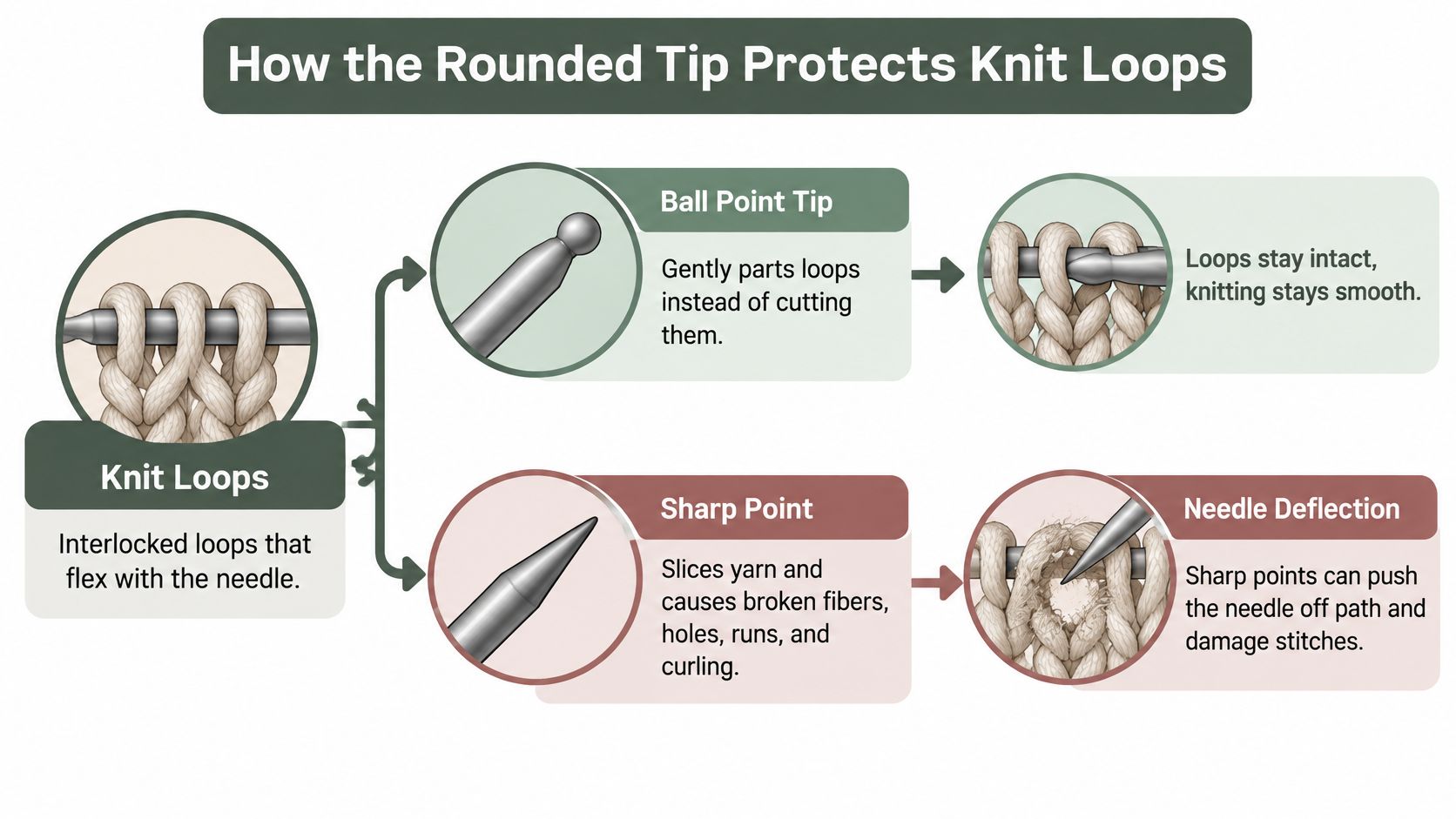
A knit holds together because each loop pulls through the loop below it. Cut one yarn and you haven't just made a hole. You've broken a link in a chain, and neighboring loops can slip free under stretch. That's why knit damage often appears after sewing, during wearing, washing, or loading on a frame, rather than at the moment the needle struck.
Think of easing a finger between the loops of a sweater versus stabbing a pin through the yarn. The finger spreads the structure and the loops recover. The pin can sever a strand. A ball point works like the finger, at machine speed. Wikipedia's sewing machine needle entry describes how the rounded tip pushes between yarns rather than cutting directly through them, reducing broken fibers, snags, and ladder-like runs.
The stitch forming hardware behind the tip
Protection is only half the job. The needle also has to present a thread loop the hook can catch. Many ball point designs use a modified eye, a reduced blade above the eye, and a deeper scarf. Those features enlarge and stabilize the loop, improve hook access, and help limit skipped stitches and needle heating during operation. A sharp tip creates a second problem here. It can catch yarn, deflect slightly, and shift the loop away from the hook point.
Take dense sweatshirt fleece with a 90/14. A ball point parts the loops, stays on path, and forms a consistent loop stitch after stitch. A sharp point of the same size may penetrate easily, but it tends to cut loops and leave runs along the seam. Same diameter, opposite result. The tip protects the fabric and the eye and scarf geometry protect the stitch, so I treat them as one buying decision, not two.
Ball Point vs Sharp, Universal and Stretch Needles
Four point families cover most of the confusion at the needle wall. The practical difference shows up after stitching, when the seam is pulled across the knit and the fabric has to recover.
| Needle point | Tip and eye design | Best fabrics | Seam behavior under stretch | Risk if misused |
|---|---|---|---|---|
| Sharp (Microtex) | Slim acute tip for piercing | Quilting cotton, batiks, tightly woven apparel fabric | Pierces woven yarns cleanly, but cuts knit loops | Runs, holes and skipped stitches on knits |
| Universal | Slightly rounded tip, standard eye | Everyday wovens and stable knits | May tolerate an occasional stable knit | Can still pierce fine knits |
| Ball point (jersey) | Rounded tip with deeper scarf | Jersey, interlock, ponte, French terry, fleece | Parts loops so the seam stretches with fewer broken yarns | Less crisp stitch placement on dense wovens |
| Stretch | Rounded tip with special eye and scarf | Elastane-rich knits, swimwear, activewear, Lycra | Supports stitch formation while elastic fabric moves | Unnecessary on stable knits and unreliable on wovens |
Sharp is the precision tool. On quilting cotton, batik, and tightly woven apparel fabric, it places stitches exactly where you aim them. On a knit, that piercing is the defect.
Universal sits in the middle. Its slightly rounded tip can survive an occasional stable knit, but an 80/12 universal on a cotton-spandex tee can start leaving runs within a few rows. The same needle may perform acceptably on a firmer interlock while marking a lighter jersey.
Ball point is the default for stable knits because the rounded point protects loop formation as the seam stretches. The trade-off is real. On dense wovens, the tip pushes threads aside instead of entering precisely, so straight stitch placement can look less crisp.
Stretch belongs where the fabric itself moves during penetration. Coats' needle guidance pairs these needle styles with higher-elastane knits and elastic materials. Inside the ball point family, match the grade to knit weight: lighter points for fine jersey and lightweight merino, medium points for fleece, double knits, French terry, and ponte.
Wovens get sharp, stable knits get ball point, high-elastane knits get stretch, and an uncertain project starts with the lighter ball point on a scrap.
For longarm work where thread and needle have to be matched as a set, the longarm thread, bobbin, and Groz-Beckert needle combination in white Glide and Magna-Glide is built around that pairing. Choose the point for the knit, then confirm that the needle system, thread and machine setup support it.
Knit Projects That Need a Ball Point Needle
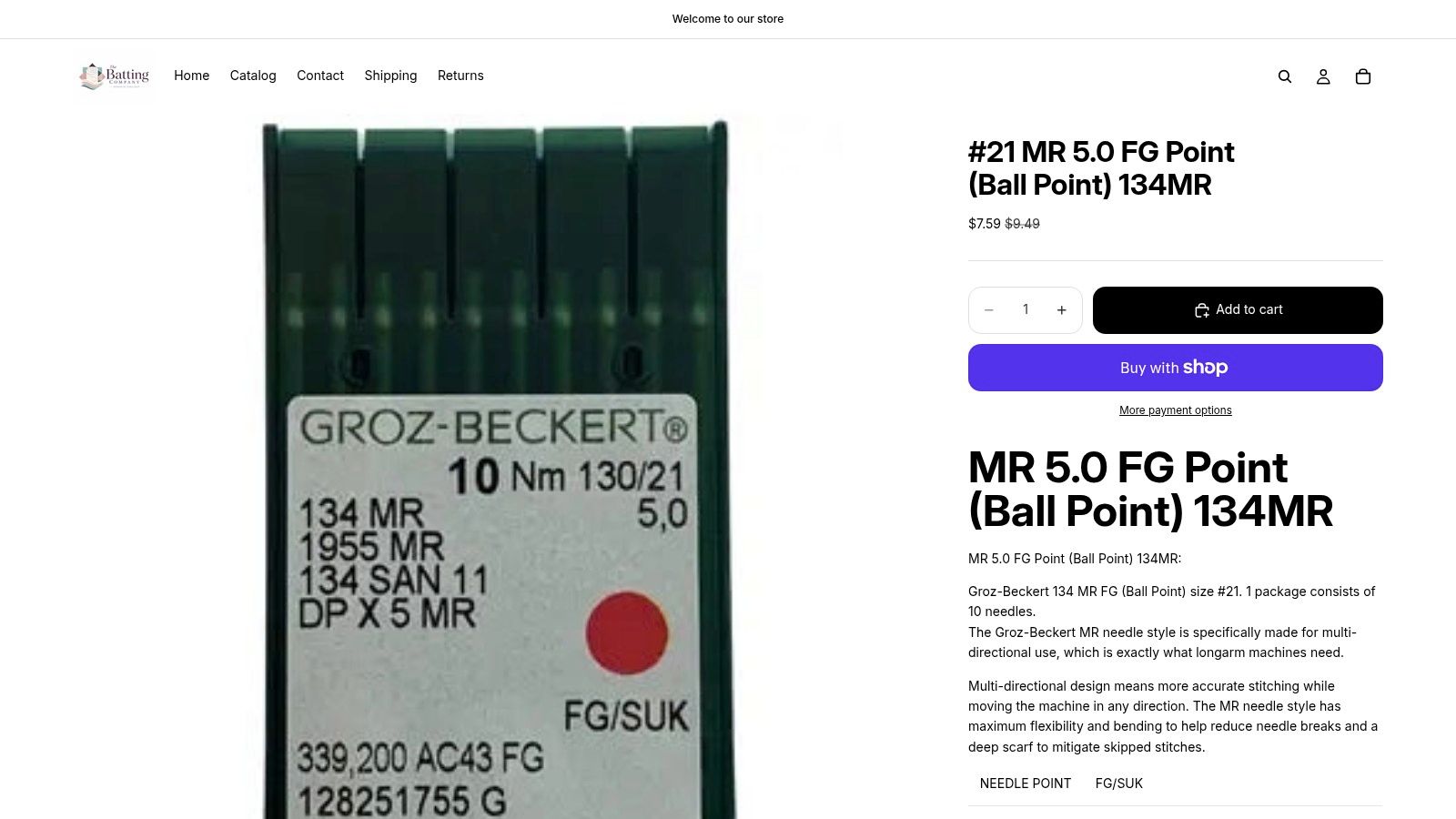
A T-shirt quilt is the clearest longarm case. The top is knit jersey, usually stabilized, and it gets stitched in every direction the machine head travels. If you stabilize with Steam-A-Seam 2, you can sew through it without gumming up your needle. That multi-directional movement is what the #21 MR 5.0 FG Point (Ball Point) 134MR is made for: a Groz-Beckert 134 MR FG in size #21, with maximum flexibility and bending to help reduce needle breaks and a deep scarf to mitigate skipped stitches. Check the 134 (MR) system against your frame manual before ordering, and confirm compatibility on the product listing itself. A mismatched system causes repeated breaks even when the point choice is correct.
The listing shows the full specification format to verify: point, size, system, and machine fit. Run through all four before a needle goes near a customer's quilt.
Domestic projects matched to the chart
- Interlock baby clothes: Start with a 70/10 or 80/12 light ball, because the fabric is smooth, fine, and easily marked by excess diameter.
- French terry hoodies: Move to a 90/14 medium ball once you're crossing pocket and hood seams, and test the thickest intersection first.
- Ponte pants: An 80/12 medium ball usually penetrates cleanly without pushing the dense double knit ahead of the foot.
- Ribbed cuffs: Stay with an 80/12, ease the pressure, and don't stretch the ribbing as it feeds or the seam will ripple.
For the knit quilt's inner layer, match a Hobbs or Pellon batting to the quilt's weight and confirm the roll or package dimensions on the product page before you order. Read the exact product's maximum quilting distance, shrinkage, and washing instructions before deciding, and allow extra batting as required by your quilting method or longarm provider. A stretchy top over the wrong inner layer will fight you at the frame. Needles are machine parts, so match the system to your machine and the point and size to the project in front of you.
Fixing Skipped Stitches and Snags on Knits
Skipped stitches are a system problem, not a tip problem with a single culprit. Fabric, needle condition, size, thread, pressure, and timing all feed the same hook and loop event. Change one variable at a time, in this order, so you know what fixed it.
- Replace the needle first. A worn or bent ball point can't separate loops cleanly. Skipped stitches, snagging, an audible pop on penetration, or visible seam damage means that point is finished.
- Verify size and point grade against the fabric chart. A fresh needle in the wrong grade repeats the failure faithfully.
- Check orientation, insertion depth, and the thread path. A needle seated a fraction low changes loop timing more than most tension adjustments do.
- Match the thread. Singer's machine needle guide for choosing the right needle notes Brother's recommendation of ballpoint needles in 75/11 to 90/14 for jersey and tricot with knit thread sizes 50 to 60, and distinguishes chromium ball point needles for greater durability at high stitching speeds in embroidery machines.
- Ease presser foot pressure and test on a scrap under real tension, stretching the seam as the finished item will stretch.
- Check timing and the hook if skipping persists. Don't size up to mask a timing fault.
Warning: Reaching for a bigger needle too soon enlarges holes and marks delicate knits. It's the most common way a fixable skip becomes permanent fabric damage.
High-speed work adds one more variable. On an embroidery machine running long fills, a chromium ball point lasts longer than a standard finish, so replacement intervals and speed belong in the diagnosis. A complete longarm maintenance kit with needles, lubricant, magnet, and bobbins keeps those checks in one place for frame work.
| Symptom | Likely cause | Fix to try first |
|---|---|---|
| Skipped stitches on knits | Worn, bent or wrong-size needle; small thread loop | Replace the needle, then verify size against the fabric chart |
| Runs, holes or curling along seams | Sharp or universal tip cutting knit loops | Switch to the correct ball point grade for the fabric weight |
| Skips only on very stretchy seams | Elastane-rich fabric needs a stretch needle eye | Try a stretch needle and ease presser-foot pressure |
| Repeated needle breaks on a longarm | Wrong system or point for multi-directional motion | Use a multi-directional MR ball point in the correct size |
| Damage worse after upsizing | Needle diameter too large for a delicate knit | Drop to a lighter ball point and retest on a scrap |
Ball Point Needle Questions Quilters Ask
How often should a ball point needle be replaced
Swap it at the first skipped stitch, snag, or audible impact. A dull rounded tip stops separating loops cleanly and starts shoving them. Needles are cheap compared with a laddered quilt top. The symptom table in the troubleshooting section above covers what each failure sign means; here the rule is simple. I don't negotiate with a suspect point.
Does my machine take the same needle system as the longarm example
Check the system designation against your machine manual or the frame brand's compatibility list before ordering. A system mismatch causes breaks and timing trouble even when the size and point grade are right. For readers who want background on thread alongside needle choice, the store lists a Let's Talk Thread PDF document.
Can a ball point needle sew a woven quilting cotton top
It can, but stitch placement is less crisp on dense wovens because the rounded tip pushes threads aside instead of piercing between them. Use a sharp or Microtex needle for woven cotton piecing and quilting. Keep the ball point for knit layers, where that push is the whole point.
Stock the Right Ball Point Needles for Your Next Knit Quilt
Stock by system first, then by the point grades you sew. For a single knit quilt on a compatible longarm, the #12 MR 2.5 FFG Point (Light Ball) 134MR covers fine jersey, and its sale price is $7.59. The Groz-Beckert 134 MR FFG is a light ball grade built for multi-directional stitching, with a deep scarf that helps the hook pick up the thread loop rather than skipping it. Pair it with a pre-cut Hobbs or Pellon package matched to the quilt's weight, chosen by the fiber and dimensions listed on the product page.
For repeated tops, buy the point grades you burn through and take the batting by the roll. Hobbs Heirloom 80/20 comes as a 96-inch by 30-yard natural roll at $199.99, a 120-inch-wide 30-yard roll at $229.16, and a black 108-inch-wide roll at $208.33. Match the needle size to the fabric chart before stitching, test on a scrap cut from the actual top, and allow extra batting where your quilting method or longarm provider requires it. If you are still building out the workroom, the guide to quilting supplies for beginners covers the supporting tools.
Order the light ball for the jersey in front of you, and keep a medium ball on hand for the fleece that follows it. Then pair that grade with Hobbs batting and Pellon materials chosen by exact fiber, dimensions, and quilting distance, all stocked alongside the sewing needles at The Batting Company.